Wednesday, 23 February 2022

What is Cardiopulmonary Resuscitation (CPR)?


What Does CPR Mean?

CPR is short for Cardio Pulmonary Resuscitation. It is a technique used to save a person’s life that has a sudden cardiac arrest. During this procedure, a person initiates a series of steps in order to help the victim’s blood continuously circulating and maintaining oxygen levels in the body. The steps include breathing (“rescue breaths”) into the victim’s lungs and compressing the victim’s chest. Let’s break this down even further to better understand CPR.

Cardio

The word “cardio” basically means the heart. Our heart is one of the most important organs in our bodies. The heart is a very strong muscle, found in the chest, which expands and contracts more than 60 times every minute and pumps blood, which is rich in oxygen, from the lungs to the rest of the organs in the body. If the heart stops pumping that all-important oxygenated blood to the rest of the body, tissue begins to die because the body’s vital organs are being deprived of the oxygen it needs to survive. This can lead to organ malfunction, brain damage or, in the worst case, death.

Pulmonary

The word “pulmonary” essentially means the lungs. The lungs are as important as the heart because when you take a breath (which you do up to 25 times a minute!), you fill your lungs with much needed oxygen and that oxygen combines with sugar to fuel your body and its vital organs. Since the tissues in our body do not store much oxygen, it is essential that they remain constantly oxygenated.

Resuscitation

The “R” in CPR is the most important letter and it means “resuscitation.” It basically means bringing someone who is apparently “dead,” back to life. It sounds more like a sci-fi movie than it really is. The human body only has a short supply of oxygen once the heart stops and the lungs are no longer receiving adequate oxygen. Once it runs out of oxygen, cell and tissue damage ensue, which can lead to brain damage and even death. When resuscitating a victim, it is important to remember that without oxygen, cell and tissue death begins between four and six minutes after being deprived of oxygen.

Importance of CPR

Cardiopulmonary Resuscitation (CPR) can be lifesaving. It helps keep the blood circulating and delivers oxygen to the body until treatment from a medical professional is available. There is usually sufficient oxygen in the blood to keep the victim’s brain and other vital organs alive, supported for a few minutes. Still, it is not circulating until someone accomplishes CPR. Keeping the blood flow active allows for successful resuscitation once trained medical staff arrives on site.

Although there is no guarantee that a cardiac arrest victim will survive CPR, it provides the victim with a chance. According to the American Heart Association, Cardiopulmonary Resuscitation can double or triple the chances of survival after cardiac arrest. Without performing CPR, it will only take a few minutes for the victim’s brain to become injured due to a lack of oxygen.

 Enroll Now for Online CPR/AED Training & Certification Classes at just $19.95.  

Read the complete article here.

Wednesday, 26 January 2022

Types of First Aid

When health emergencies occur, the responder needs to act first to figure out the type of emergency and figure out the appropriate solution. There are different first aid procedures, which vary depending on the type of emergency and the age of the victim.

  • Different types of wounds: Wounds result from injuries that cause the skin to open or tear up. The first aid for wounds depends on the cause of the injury and severity. These injuries can result from injuries by fire, hot objects, and fluids. Wounds could also occur from falls, cuts by sharp objects, and piercings. When providing first aid for damages, you need to assess the cause. Always keep in mind that injuries can quickly get infected and need to be handled with care.
  • Fractures and sprains: Fractures are cases of broken bones, while sprains occur from the injury of ligaments and tendons located within joints. Fractures are more severe and require should be treated as health emergencies. On the other hand, Sprains often heal on their own following a simple first-aid procedure and require less medical attention. Fractures are very painful and will at times require medical diagnosis through an X-ray to establish. You, therefore, need to pay special attention to such an injury to avoid further damage.
  • Animal and insect bites: an animal bite needs to be treated by trained medical personnel. Some animal bite injuries could be fatal depending on the type of animal and its health status.
    Insect bites can also lead to poisoning as well as an allergic reaction. The first aid procedures vary depending on the type of insect or animal.
  • Heat-related illnesses: these are injuries that occur from extreme temperatures. It could be extreme heat, heat exhaustion, or extreme cold (hypothermia and frostbites). Also, there are different first aid procedures for either.
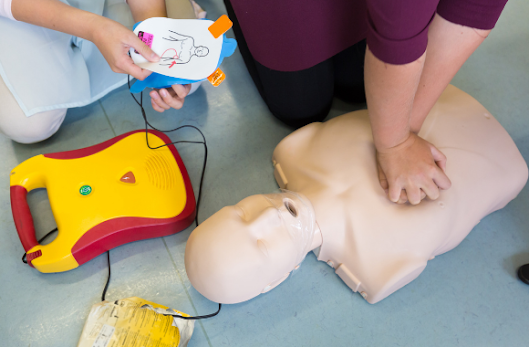
  • CPR: CPR is a critical life-saving technique that applies to victims of cardiac arrest and choking. The procedure involves chest compressions and the use of the AED. The method for performing CPR is covered intensively in CPR certification and AED classes.

In CPR, the rescuer uses chest compressions to maintain blood circulation by providing an artificial heartbeat to the victim. The AED device is used to restore regular heart activity. Both of these procedures are critical in cardiac arrest cases. The faster they are performed, the better the chances of survival of the victim.

In most training institutions, both CPR and AED are covered under the same certification program. Just like first aid certification, CPR and AED certification is also available online and is open to all.

When choosing first aid and CPR classes, it is best to for a recognized training institution. There are many CPR and first aid training institutions available online, all promising to be accredited. However, you need to research these institutions’ credibility and choose one with excellent ratings and is AHA accredited.

Read the complete article here.

 Enroll Now for Online CPR/AED Training and Certification Classes at just $19.99.  

Benefits of Online CPR Training Classes During Covid 19 Crises

Here are some of the reasons why online CPR training has become successful during the Covid-19 pandemic:

      I.  CPR training is highly needed during this time

The Covid-19 pandemic has brought to the surface the fact that life is very fragile. One moment someone is totally okay and the next minute they are fighting for their life. The case is even worse in a household with someone with underlying medical conditions. In an instance when someone stops breathing abruptly, offering timely help means a lot in saving a life.

You might have missed a chance to take CPR training before the pandemic. But during this time, you have realized how essential the training is. The fact that you have an option to get CPR certification online makes things easy. You will totally agree with us that the Covid-19 pandemic has made it even more important for one to acquire CPR skills.

Here is why, for starters the Covid-19 virus can contribute to cardiac arrest cases. Some of the complications that come with the infection are respiratory failure, cardiac failure, pneumonia, and other organ failures. These symptoms appear suddenly and getting an ambulance may not be as fast enough as the right CPR skills would be in saving a life.

The other reason is that we have witnessed situations where many people avoid hospitals when they are corona virus negative. This simply means that people don’t go to hospital when they have symptoms of an impending heart attack. Therefore an attack can possibly happen when outside the hospital and that’s where CPR training comes in handy.

The fact that CPR training has become highly essential during this time has contributed to the overall success of online CPR certification. 

    II. Online CPR certification is very safe

Online training is the safest way to acquire CPR certification. Taking an in-person class means that you will have to interact with fellow students while taking the class. In as much as you will be having your masks on and keeping a considerable distance, you may still be worried about the risks of infection. These concerns are even more heightened when you have vulnerable relatives back home.

The option of acquiring online CPR/AED certification makes things easy and safe for everyone during the pandemic. All you need to have is a reliable internet connection, a laptop, computer, iPad or even a smartphone! The issue of safety has contributed highly to the success of online healthcare training.

  III. Online CPR training offers access to convenient and high quality learning

Numerous concerns have been raised on the effectiveness of online learning, Traditionally, we are accustomed to learning with an in-person instructor in a mortar and brick classroom. The Covid-19 pandemic has helped us realize how effective online learning can be. Here are some of the reasons why acquiring online CPR certification is not only convenient buy also efficient:

Ø  Online CPR courses are tailor-made to suit each student. They allow you to acquire the knowledge and skills that you really need.

Ø  Online CPR training allows you to learn at your preferred pace. You’ll have a chance to take the classes based on a schedule that is convenient to you and complete the course at your own speed.

Ø  Online CPR training gives you the option of constant access to the learning materials. You have a chance to read, watch and test yourself as many times as possible until you are satisfied that you have fully mastered the content.

Ø  Online CPR certification also offers you access to approved courses. For example, you can find online courses that are OSHA compliant. You can also get courses that comply with industry-leading ILCOR standards and are A+ rated.

The convenience and efficiency of online CPR training has had a huge impact on its success in the face of the Covid-19 pandemic.

  IV. Online CPR training has put into consideration Covid-19 safety procedures

In as much as you may be trying to save a life, your personal safety while at it is also important. As you perform CPR, you also want to minimize the risks of contracting the virus. Online CPR training has included specific additional courses to improve the overall safety from corona virus for the individual performing CPR. Learners are taught the additional steps they need to take to protect themselves during this time.

Some of the precautions that are highlighted include:

Ø  Wearing personal protective equipment like masks and gloves while performing CPR.

Ø  Performing hands-only CPR.

Ø  Getting a CPR pocket mask that minimizes the number of contagious respiratory materials that get to you.

Read the full article here.

 Enroll Now for Online CPR/AED Training & Certification Classes at just $19.95.  

Tuesday, 28 December 2021

Online CPR vs On-Campus CPR Training

Find out the basic difference between the online CPR certification and On-campus CPR training.


Read more about online CPR training and certification classes at CPR Select.


Tuesday, 23 November 2021

Factors Should Be Considered to Ensure Perfect CPR


The following factors should be considered to ensure perfect CPR:

Compression Rate

The clear priority during CPR is establishing effective compressions for the patient. If the rescuer cannot coordinate the patient’s breathing, like finding it too time-consuming or unpleasant, the patient may die. An effective chest compression alone has a lot of benefits. Compression rate, which measures how fast CPR is performed, should be between 100 and 120 compressions in one minute. The person administering CPR should ensure that chest compressions are not too slow. If the compressions are too slow, the blood is not being circulated efficiently around the body. On the other hand, if compressions are very fast, the heart is not given enough time to be filled with blood. This means that the cardiac output will definitely fall off. Thus for effective CPR procedure, compression rate should be performed carefully professionally.

Compression Depth

Compression depth is another factor that should be considered very crucial for effective compressions during CPR. It measures how deep the center of the chest — sternum- is pushed down when CPR is being performed. For most adults, the preferred depth compression is two inches. The chest should be allowed to fully recoil after every compression. This is equally important as it will enable the heart to be filled with blood which consequently helps to improve cardiac output.

Compression Fraction

Compression fraction simply means the amount of time taken during a cardiac arrest while performing a CPR procedure. It also means that for cardiac output to build up again, it will take time. It is therefore, reasonable to minimize interruptions during CPR so that high-quality resuscitation is gained. Suppose the bystander administering CPR gets tired and wants to exchange with another person to continue administering CPR. In that case, the exchange should not exceed 10 seconds. The compressions should continue as the other rescuers place an AED if it is available.

Ventilatory Rate

For patients that require ventilation, ventilation rate is the rate at which ventilations are delivered mostly through a bag-valve mask. Ventilation rate should be regulated as hyperventilating or over ventilating can greatly affect the outcome of effective CPR. For instance, increased pressure in the chest cavity may be caused by too much ventilation.

Source

Tuesday, 21 September 2021

Benefits of Group CPR Certification

Check out the advantages of group CPR certification classes and how it helps organizations in getting their employees trained in the basic CPR skills.


Read more about Group CPR Certifcation.